

 Data Annotation
 Data Sourcing
 Machine Learning (ML)
 Tech Annotation
 Robotics AI Data Operations
 Analytics
 Content Moderation
 Medical Annotation
 Off-the-Shelf (OTS) Datasets for AI Training
 Global Talent Data Intelligence
 Talent Consulting & Strategy
 Strategic Recruitment Solution
 Contract Staffing
 Recruitment As A Service (RaaS)
 Executive Search
 RPO Solution
 IT Services Recruitment
 Research and Consulting
 Executive & Leadership Hiring
 BPO Recruitment
 Diversity Hiring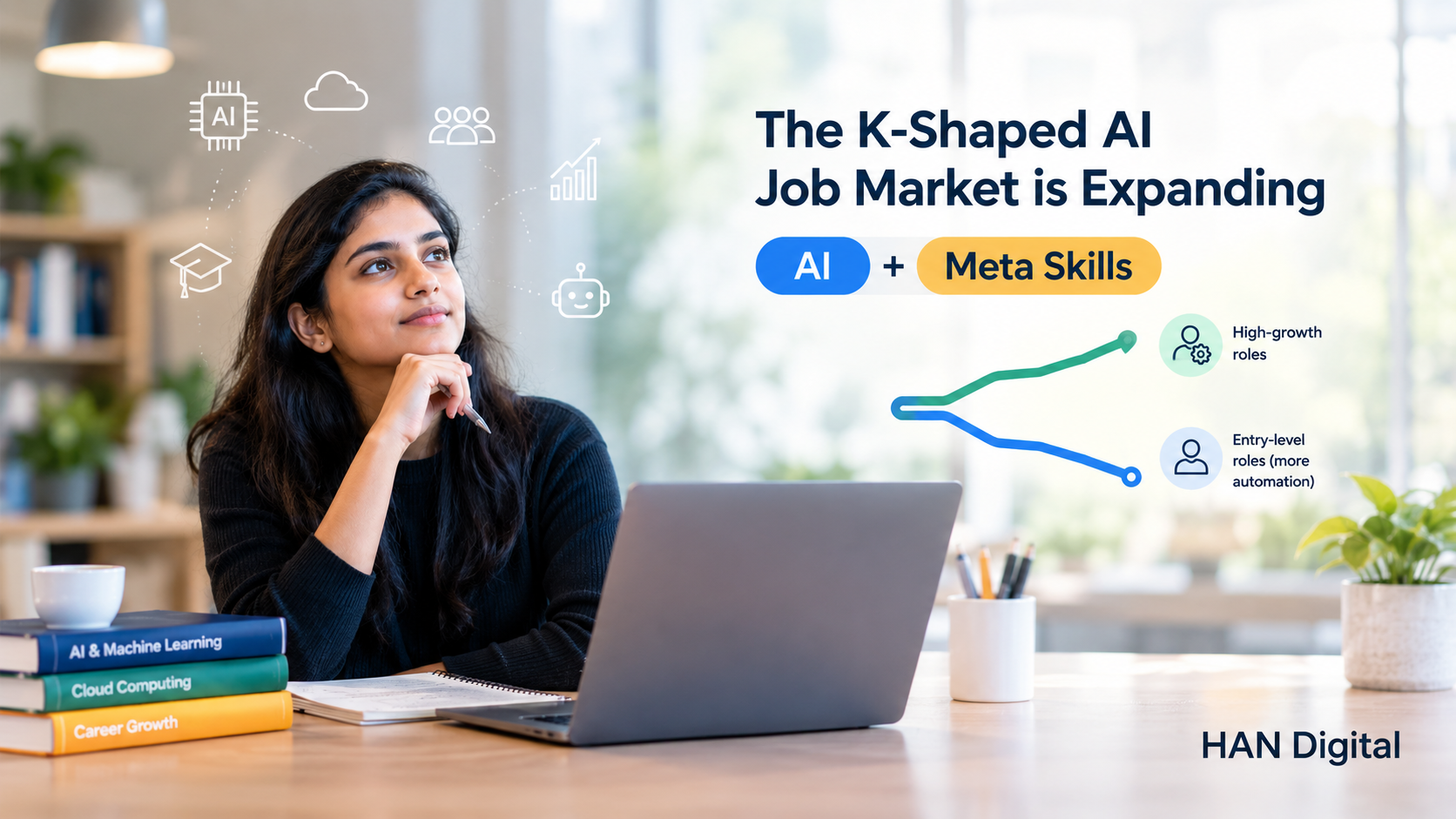
AIM Panel Discussion: India Is Training Millions for AI Jobs That Nobody at Entry Level Can Actually Get
Sep 3, 2026.
Saravanan Balasundaram, Founder & CEO, HAN Digital, shares his perspective at an AIM panel discussion on India’s evolving AI employment landscape.
India is training millions of professionals for an AI-driven economy, but the bigger challenge is increasingly whether entry-level talent is ready to contribute from day one.
Speaking at the AIM panel discussion “India Is Training Millions for AI Jobs That Nobody at Entry Level Can Actually Get,” Saravanan Balasundaram highlighted the emergence of a K-shaped job market, where demand is rising for AI and data engineering, AI fluency, systems thinking and deep domain expertise, while routine and manual work faces increasing automation.
The AI Talent Gap Is Becoming a Readiness Gap
According to Saran, the shortage of AI talent is no longer simply about the number of people who have completed AI training / certifications. Employers increasingly need professionals who can contribute to production-ready code, AI system deployment and live projects with limited additional training.
Factors such as compensation expectations, intense competition for experienced talent, geography and counter-offers are further widening the gap between available talent and immediately deployable talent.
Can Freshers Become Deployment Ready?
Saran believes they can; but not through classroom training alone.
“Not from day one, but they can become deployment-ready within a few weeks with the right exposure.”
The traditional model of spending several months in training before entering a project is becoming less relevant for many AI roles. Freshers need earlier exposure to real data, infrastructure, internships, live AI projects, PoCs, production-like environments and hands-on problem solving.
The objective is to shorten the distance between learning and delivery.
The K-Shaped AI Job Market
The changing employment landscape is creating two very different directions of demand:
Growing demand
AI & Data Engineering
AI fluency and emerging AI skills
Systems thinking
Domain expertise
Production-oriented engineering
Declining demand
Routine and repetitive tasks
Manual processes increasingly handled by AI and automation
Floor-level physical tasks increasingly influenced by robotics and Physical AI
This does not necessarily mean technology will permanently reduce employment. The Luddite fallacy reminds us that while new technologies can eliminate specific jobs in the short term, they can also increase productivity, create new markets and shift workers into new roles.
Rebuilding the Entry Pathway
For Saran, the answer is not to slow AI adoption, but to rebuild how talent enters the AI workforce.
Freshers need pathways that connect learning with real-world execution through internships, live projects, apprenticeships, PoCs and production-like environments.
The question for employers is therefore changing:
Can a fresher realistically become deployment-ready without access to real data, infrastructure and production-like environments?
The answer is Yes, with the right exposure and a significantly shorter transition from training to delivery.
At HAN Digital, this principle informs how AI and digital operations talent is developed: creating a career pathway from foundational skills to production readiness, rather than treating entry-level AI work as a dead end.
Watch the AIM panel discussion: https://www.youtube.com/watch?v=tGz5QSnKDXo