

 Data Annotation
 Data Sourcing
 Machine Learning (ML)
 Tech Annotation
 Robotics AI Data Operations
 Analytics
 Content Moderation
 Medical Annotation
 Off-the-Shelf (OTS) Datasets for AI Training

 Global Talent Data Intelligence
 Talent Consulting & Strategy
 Strategic Recruitment Solution
 Contract Staffing
 Recruitment As A Service (RaaS)
 Executive Search
 RPO Solution

 IT Services Recruitment
 Research and Consulting
 Executive & Leadership Hiring
 BPO Recruitment
 Diversity Hiring
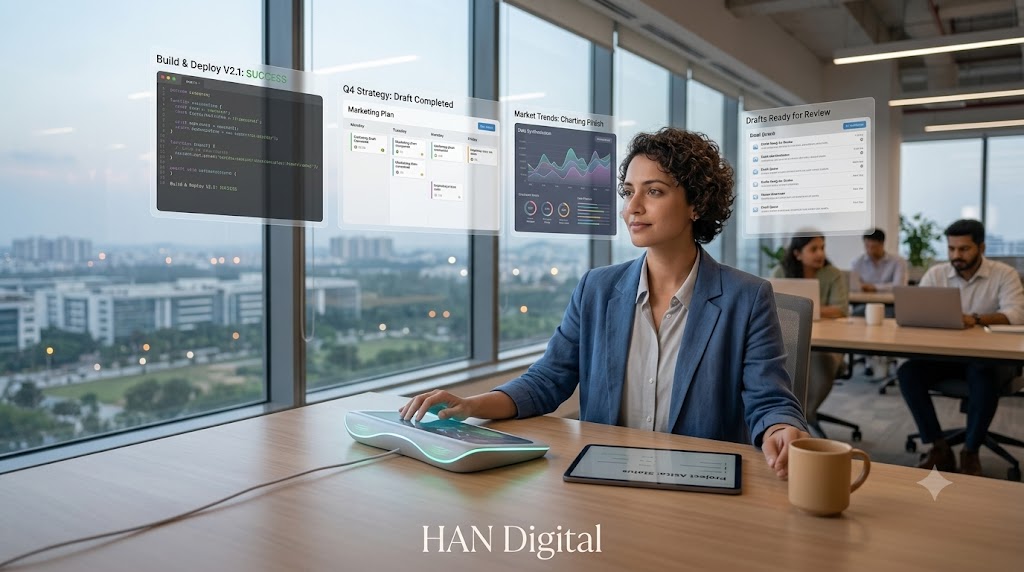
HAN Digital’s Saravanan Balasundaram Featured in Times of India’s “Times Techies” on the Shift From AI Assistants to AI Agents
Sep 2026: The launch of GPT-6 Astra marks an important shift in the evolution of enterprise artificial intelligence from systems primarily designed to generate answers and recommendations toward AI systems capable of planning, using tools, navigating software, executing multi-step tasks and producing finished work.
OpenAI describes GPT-6 Astra as its most capable model for demanding work, with significant advances in computer use, software engineering, browsing, science, cybersecurity and professional workflows. The model can interact with computer applications, conduct research, create documents and presentations, write and test software, and carry out extended sequences of actions with less human intervention.
For Saravanan Balasundaram, the significance of Astra goes beyond another improvement in model intelligence.
“The real shift is not that AI has become better at answering questions. The shift is that AI is becoming capable of taking ownership of the work between the question and the outcome.”
From Prompting to Delegating
The first phase of generative AI was largely centred around prompting that asking a model to write, summarize, analyze, brainstorm or generate code.
The next phase is increasingly about delegation.
Instead of asking AI:
“Give me a market analysis.”
a more advanced AI workflow can potentially be asked to:
Research → collect information → analyze data → identify patterns → create the analysis → prepare the presentation → validate the output.
GPT-6 Astra’s computer-use and professional-work capabilities are designed around precisely this kind of multi-step execution. OpenAI says Astra can work with existing computer applications, including workflows where APIs are unavailable, allowing AI to operate within tools businesses already use.
Saravanan believes this will fundamentally change the productivity equation.
“We are moving from AI as a co-pilot to AI as an execution layer. The value will increasingly come from how well organizations redesign work around AI, not simply from how many employees have access to an AI chatbot.”
The Emergence of AI-Native Workflows
The implication for enterprises is significant.
Many business processes today still consist of multiple disconnected steps:
Research → Analysis → Decision → Execution → Review → Reporting
Humans traditionally move information from one system to another and coordinate each stage.
AI agents are increasingly capable of operating across these steps.
This creates the possibility of AI-native workflows, where humans define objectives, constraints and checkpoints while AI handles significant portions of the execution.
Examples include:
-
Market and competitive research
-
Data analysis and reporting
-
Software development and testing
-
Customer and CRM operations
-
Document preparation
-
Financial and operational analysis
-
Website creation and quality assurance
-
Knowledge management
-
Research-intensive professional services
GPT-6 Astra’s ability to combine reasoning with computer use is particularly relevant to these workflows. OpenAI reports that Astra can interact with applications, perform online research, create websites, analyze data and execute complex professional tasks.
The Human Role Is Not Disappearing. It Is Moving Up the Stack
The human role is likely to move toward problem definition, judgment, exception handling, governance, domain expertise and outcome ownership.
“The important question is no longer ‘Can AI do this task?’ The better question is ‘How much of the entire workflow can AI responsibly own, and where should human judgment remain in the loop?’”
This distinction will become increasingly important as AI systems move from generating individual outputs to operating continuously across business processes.
A New Skill Requirement Is Emerging
The evolution of models such as Astra also changes what it means to be AI-skilled.
Knowing how to write effective prompts remains useful, but it is becoming only one component of a broader capability.
The emerging AI professional needs to understand:
Business problem → Workflow design → AI orchestration → Tool selection → Data → Validation → Automation → Human oversight
This is creating demand for professionals who can combine domain knowledge, AI systems thinking and execution capability.
This as an important development for the future of enterprise talent.
“The next generation of AI talent will not be measured only by how well they use an AI model. They will be measured by how effectively they can design, orchestrate and continuously improve AI-driven systems around real business outcomes.”
From AI Tools to AI Systems
The launch of GPT-6 Astra therefore represents more than another step in the model race.
It points toward a broader transition:
AI 1.0: Generate content
AI 2.0: Reason and assist
AI 3.0: Use tools and execute workflows
AI 4.0: Operate continuously toward defined outcomes
The competitive advantage for enterprises may increasingly come from the ability to build the infrastructure, data processes, governance and talent required to support this transition.
For organizations, the question is no longer simply “Which AI model should we use?”
It is becoming: