

 Data Annotation
 Data Sourcing
 Machine Learning (ML)
 Tech Annotation
 Robotics AI Data Operations
 Analytics
 Content Moderation
 Medical Annotation
 Off-the-Shelf (OTS) Datasets for AI Training

 Global Talent Data Intelligence
 Talent Consulting & Strategy
 Strategic Recruitment Solution
 Contract Staffing
 Recruitment As A Service (RaaS)
 Executive Search
 RPO Solution

 IT Services Recruitment
 Research and Consulting
 Executive & Leadership Hiring
 BPO Recruitment
 Diversity Hiring
AI Is Rewriting India’s IT Hiring Pyramid: From Mass Recruitment to Precision Talent
October 2026,
Artificial intelligence is changing not only how technology work is performed, but also how companies hire, what skills they prioritize and how workforce structures are designed.
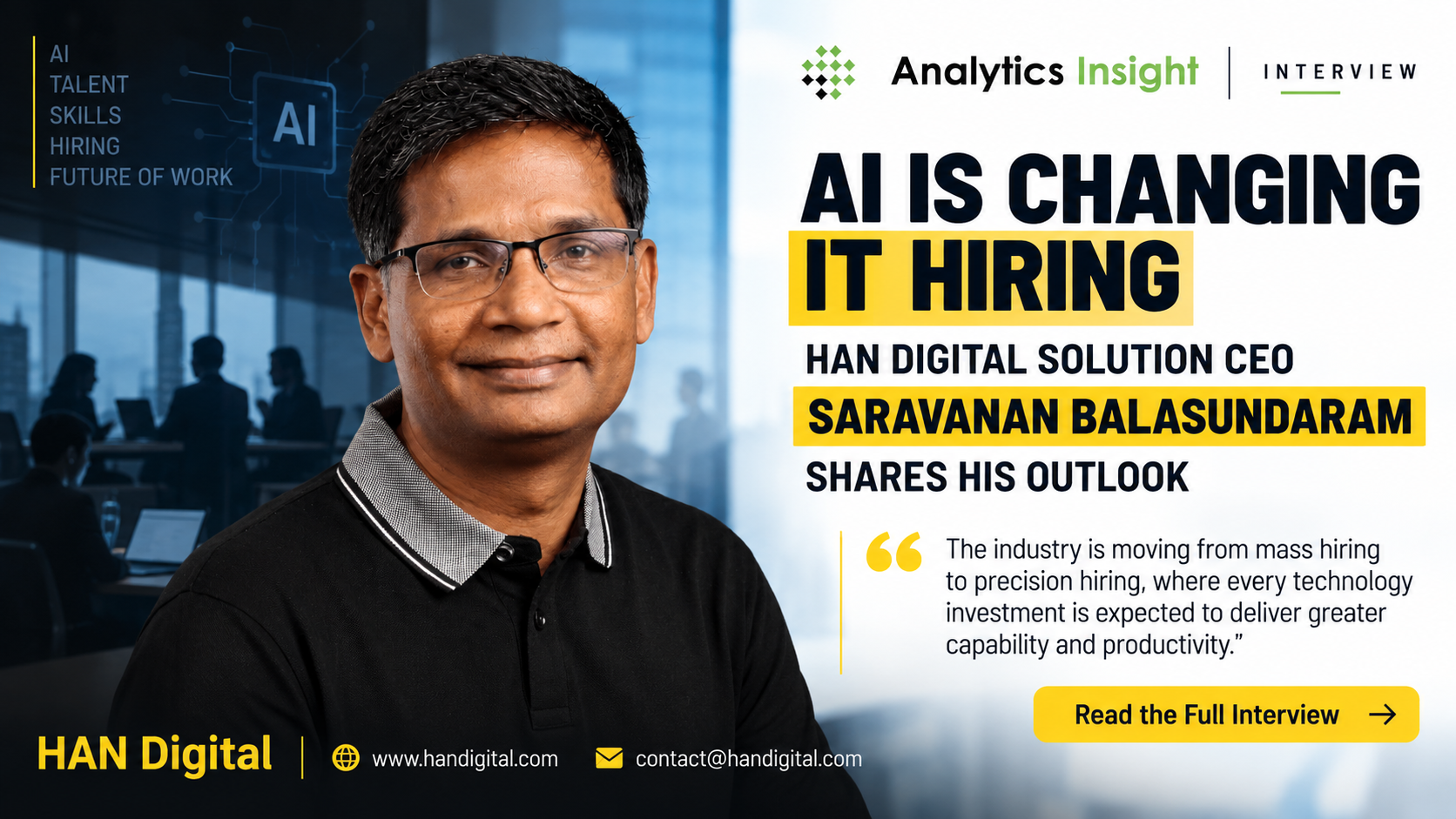
Saravanan Balasundaram, Founder & CEO of HAN Digital, shared market view with Analytics Insights about how India’s IT-BPM industry is moving from volume-based hiring toward skills-driven, precision hiring, with productivity and business outcomes becoming increasingly important.
From Mass Hiring to Precision Hiring
India’s IT services industry traditionally relied on large-scale graduate hiring and structured training pipelines. AI is now changing that model by automating portions of repetitive, analytical and rules-based work.
As a result, organizations are increasingly looking for professionals with deeper capabilities in AI, data, cybersecurity, cloud, enterprise platforms and AI-enabled engineering.
“The industry is moving from mass hiring to precision hiring, where every technology investment is expected to deliver greater capability and productivity.”
This does not mean technology employment disappears. It means the composition of employment is changing.
The New Talent Equation
The demand curve is shifting toward professionals who can combine AI with technical expertise, domain knowledge and enterprise understanding.
At the same time, repetitive roles such as basic support, transactional processing, portions of QA and entry-level coding and testing are likely to face greater automation pressure.
Another emerging trend is skills-on-demand.
As enterprises and GCCs build specialized AI capabilities, flexible and project-based talent can help organizations access specific skills without maintaining every capability permanently in-house.
A Different Starting Point for Freshers
The biggest change may come at the entry level.
Traditional fresher hiring models were built around training graduates into execution-oriented roles. AI is increasingly pushing companies to look for graduates who can contribute more quickly through practical technology skills, domain understanding and AI fluency.
“Prompting is quickly becoming a baseline capability rather than a differentiator. Real AI readiness means understanding how to build, integrate and manage AI systems that can deliver business outcomes.”
For Gen Z professionals, this means developing domain depth, production ready codes, technology fluency and adaptability.
Emerging AI-Native Roles
New roles are also emerging around the AI lifecycle, including Loop Engineers and Forward Deployed Engineers (FDE) professionals who build, deploy, monitor and continuously improve AI systems in real-world environments.
The future engineer may not simply write code. They may design an AI workflow, connect it to enterprise systems, evaluate its performance and continuously optimize it.
The Hiring Pyramid Is Being Re-Architected
The AI workforce transition is therefore not simply about how many jobs disappear.
It is about which skills gain value.
“The old IT hiring pyramid was built around volume. The new one will increasingly be built around skills. people who know how to build AI, integrate it into the enterprise and work effectively alongside it.”
India’s next phase of technology hiring is likely to be more specialized, more AI-enabled, more flexible and more closely tied to measurable business outcomes.
For enterprises, the question is no longer simply how many people they need, but which capabilities they need, which work AI can perform and where human expertise creates the greatest value.
Read Full Article: AI Is Changing IT Hiring: Han Digital Solution CEO Saravanan Balasundaram Shares His Outlook