

 Data Annotation
 Data Sourcing
 Machine Learning (ML)
 Tech Annotation
 Robotics AI Data Operations
 Analytics
 Content Moderation
 Medical Annotation
 Off-the-Shelf (OTS) Datasets for AI Training
 Global Talent Data Intelligence
 Talent Consulting & Strategy
 Strategic Recruitment Solution
 Contract Staffing
 Recruitment As A Service (RaaS)
 Executive Search
 RPO Solution
 IT Services Recruitment
 Research and Consulting
 Executive & Leadership Hiring
 BPO Recruitment
 Diversity Hiring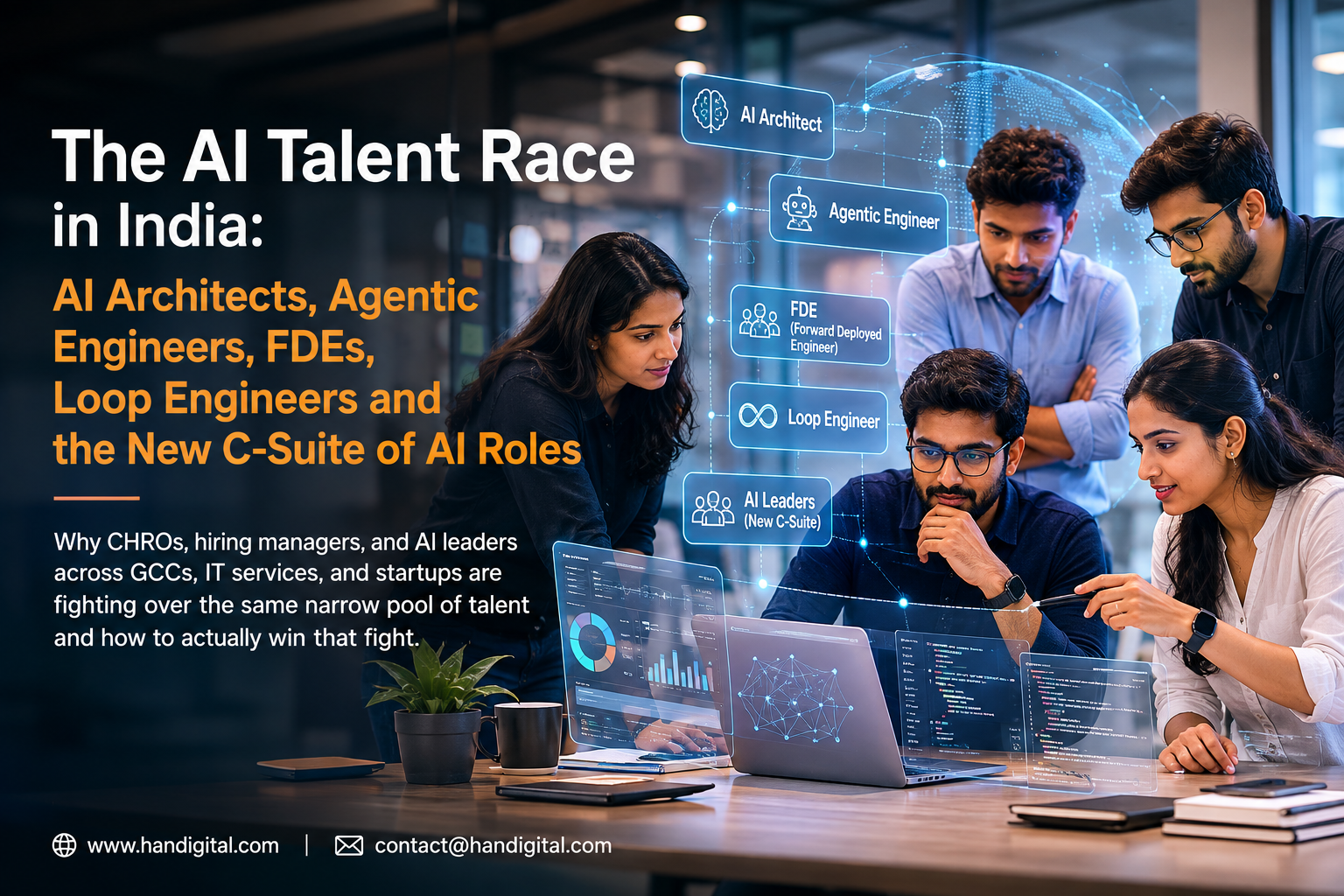
The AI Talent Race in India: AI Architects, Agentic Engineers, FDEs, Loop Engineers and the New C-Suite of AI Roles
Why CHROs, hiring managers, and AI leaders across GCCs, IT services, and startups are fighting over the same narrow pool of talent and how to actually win that fight.
The Numbers Don’t Leave Much Room for Debate
If you’re a CHRO or hiring leader in India right now, you don’t need to convince that AI hiring has changed. You need to know exactly how much, where, and what it’s going to cost you to compete.
Here’s the scale of the shift versus last year:
AI engineering job postings in India grew 60% year-on-year: the fastest growth rate among major global markets, outpacing the US, UK, France, and Germany, according to LinkedIn’s 2026 AI Labour Market Report.
Agentic AI-specific postings: the roles requiring LangChain, CrewAI, AutoGen, or general “AI agent” skills grew over 300% between January 2025 and March 2026 on LinkedIn India data.
Forward Deployed Engineer (FDE) listings rose more than 700%: the single sharpest example of role-level specialization premium anywhere in the market and HAN Digital expect this number to cross 20,000 in few years.
Indian MNCs grew AI/ML hiring by 82% year-on-year: as of February 2026, nearly double the 43% growth rate posted by foreign MNCs operating in India, per Naukri’s JobSpeak Index.
The AI-skills wage premium has more than doubled: from 25% a year ago to 56% today, according to PwC’s 2025 Global AI Jobs Barometer.
Behind every one of these numbers is the same underlying story: demand for AI talent in India isn’t growing steadily. It’s compounding and the organizations that move fastest on hiring strategy, not just hiring budget, are the ones actually closing their open AI roles.
The Roles Driving This Demand
The job titles at the center of this hiring wave didn’t exist in most org charts five years ago. Understanding what each one actually does and where it sits in your organization is now a prerequisite for building an AI hiring strategy that works.
AI Architect
Designs the end-to-end AI systems data ingestion, model deployment, monitoring, CI/CD that let enterprise AI run reliably on a scale, under real latency and compliance constraints. This is the role bridged AI engineering, cloud infrastructure, and data security, and it’s consistently one of the hardest single roles to close in 2026.
GenAI Center of Excellence (CoE) Leader
Owns the enterprise-wide GenAI roadmap standardizing tooling, governance, and best practices across business units so GenAI adoption doesn’t fragment into a dozen disconnected pilot projects. Increasingly a mandate at GCCs and large enterprises trying to move GenAI from experimentation to production at scale.
Agentic AI / Agentic Systems Engineer
Builds autonomous, multi-agent systems using frameworks like LangGraph, AutoGen, and CrewAI that doesn’t just answer a prompt, but plans, executes, and self-corrects across multi-step business workflows without constant human intervention. This is the fastest-growing skill cluster in the Indian job market right now, full stop.
Loop Engineer
A closely related but distinct discipline: designs the feedback loops that let AI agents verify their own outputs and self-correct with minimal human prompting at each step into the engineering layer that makes true autonomy safe enough for production use. Read Han Digital View on Loop Engineering
Forward Deployed Engineer (FDE)
Embeds directly with clients or business units to deploy and customize AI inside live workflows not from a central lab, but on the ground where the AI actually has to work. The 800%+ posting growth here reflects how hard it is to find engineers who can do both deep technical work and hands-on client-facing deployment. Read HAN Digital View on FDE
Frontier Engineer
Works at the edge of what foundation models can currently do, adapting frontier-level AI capability into production-safe, enterprise-grade systems translating research-stage capability into something a compliance team will actually sign off on.
AI Product Manager
Translates enterprise business problems into AI product roadmaps that organizations will actually adopt increasingly the role deciding whether an AI initiative survives past its pilot phase or dies quietly in a slide deck.
Where the Demand Actually Comes From: Three Very Different Buyers
One of the most consistent mistakes generally see in AI hiring strategy is treating “AI talent demand” as a single market. It isn’t. Based on hundreds of AI hiring demands that we manage for our external customers, these three organization types driving this hiring wave want fundamentally different things from the same talent pool.
IT Services, Consulting, Big 4, and Product Engineering Firms: We observe that these organizations need AI talent that can operationalize AI across client engagements at scale architects and engineers who can standardize delivery, not just build one-off pilots. Hiring here is increasingly filtered toward AI, data, cloud, cyber security and digital skill profiles rather than general engineering headcount, even as overall volume hiring stays cautious.
Global Capability Centres (GCCs): 60% of Indian GCCs are already investing specifically in agentic AI, and 83% are actively scaling generative AI projects, per the EY GCC Pulse Survey. Based on our research estimate, India is home to roughly 160,000 AI+data professionals inside GCCs today, against demand projected to cross one million AI-related roles in India ITBPM industry.
AI-Native Startups: According to our job market analysis, roughly 75% of newly-launched GCCs and a comparable share of well-funded AI startups now allocate 15-25% of total headcount to AI/ML roles within 18 months of launch. This segment moves fastest on hiring decisions but often has the least internal recruitment infrastructure to actually execute speed at which is exactly where an external hiring partner earns its value.
What These Roles Actually Pay in India (2026)
Role | IT Services | GCCs/Product/Startups |
Fresher GenAI roles (with project exposure) | ₹6-14 LPA | ₹8-24 LPA |
GenAI / LLM Engineer (3~10Yrs) | ₹15-50 LPA | ₹25-90 LPA |
Data Scientist (AI-specialized) (4~8Yrs) | ₹12-30 LPA | ₹30-70 LPA |
Forward Deployed Engineer (FDE) (5~10Yrs) | ₹20-55 LPA | ₹60-1.4 Cr |
AI Research Scientist (6~10Yrs) | ₹25-60 LPA | ₹70-1.75 Cr |
AI Architect (10~15Yrs) | ₹35-75 LPA | ₹65-2.0 Cr |
Head of AI / Chief AI Officer (15+Yrs) | ₹75-₹2.0 Cr | ₹1.5Cr -₹4.5Cr |
Source: HAN Digital Research
A few patterns worth building into your compensation strategy directly:
- GenAI engineers now command a 30~60% pay premium over adjacent engineering talent inside GCCs specifically.
- Company type moves pay more than title does: generalist AI engineers at IT services firms plateau around ₹15~50 LPA, while product company and GCC peers doing comparable work earn ₹25-90 LPA at the same experience level.
- Track choice matters as much as seniority: an individual-contributor AI Architect can now out-earn an AI Team Lead, because deep technical system-design capability is scarcer than management capability at this level.
Where This Talent Actually Sits
Bengaluru remains the anchor commanding a 30~35% salary premium over other Indian markets and hosting the largest concentration of AI/ML talent in the country. But the geography of this hiring wave is diffusing faster than most compensation and location strategies have caught up with:
- Hyderabad: +50% YoY growth in AI hiring, majorly in GCCs and platform players
- Pune: strong momentum across both AI and broader senior hiring in GCCs
- Gurugram, Noida, Delhi, Chennai: all active secondary hubs, particularly for agentic AI and GCC-based roles
Tier-2 cities (Coimbatore, Ahmedabad, Trivandrum, Cochin, Jaipur, Indore, Chandigarh, etc) are projected to account for 20% of total job openings in 2026, and GCC hiring share in Tier-2 locations is expected to move from 15% to over 25% by 2027 meaning any AI hiring strategy still built exclusively around metro-city sourcing is already leaving talent, and cost efficiency, on the table.
The Skills and Tools HAN Digital Actually Being Screened For
Across the roles above, a consistent technical core keeps showing up in what employers are actually testing for in 2026:
- FDE / Loop Engineers: Python, JavaScript, FastAPI, Flask, REST APIs, Agentic AI frameworks/workflows (e.g., LangGraph, CrTewAI, Agent Development Kit (ADK) and complex patterns (ReAct, self-reflection, hierarchical delegation), plus meta skills.
- Multi-agent frameworks: LangGraph, AutoGen, CrewAI, LangChain, Agno, Swarm, Autogen, etc
- LLMOps and production ML: model deployment, monitoring, retraining pipelines, not just notebook-stage experimentation
- RAG (Retrieval-Augmented Generation) architecture
- Python, PyTorch/TensorFlow, and strong software engineering fundamentals production ML increasingly rewards engineers who can ship.
- Portfolio proof over pedigree: employers explicitly prioritize candidates who can demonstrate 2-3 real working agentic AI projects over candidates with strong academic credentials
This shift of proof-of-work over credentials itself a hiring strategy signal: skills-first evaluation is becoming the default for AI hiring in India.
Why This Is a Hiring Model Problem, Not Just a Budget Problem
Here’s the uncomfortable part for most HR and TA functions: supply isn’t catching up. NASSCOM and industry partners project demand for AI professionals will exceed one million by 2026, with the talent base reaching 1.25 million by 2027 against a widening gap where talent supply grows at roughly 15% CAGR while demand expands at 25%. Only about less than 20% of existing IT professionals in India currently hold AI-ready skills.
That gap doesn’t close with a bigger budget line. It closes with the right hiring model for the right role and that’s precisely where most internal TA teams, sized and structured for a pre-AI hiring cadence, are running into a wall.
How HAN Digital Helps AI CoEs, GCCs, and Tech Startups Close This AI Talent Gap
This is the exact problem HAN Digital recruitment and leadership hiring practice is built around not generic IT staffing, but sourcing and closing the specific, scarce AI roles covered in this piece, across the organization types that need them most.
For GCCs building or scaling an AI CoE, we bring both permanent hiring for architect- and leadership-level roles that anchor a function long-term, and contract/contract-to-hire staffing for the agentic engineering and MLOps capacity that needs to scale fast around a specific initiative without the 3-6 month hiring cycle that kills AI project momentum.
For IT Services and Consulting firms re-staffing around AI-led delivery, we help identify and place the AI architects, FDEs and GenAI specialists who can standardize delivery capability across client engagements.
For AI-native startups, where speed matters more than almost anything else, our contract and contract-to-hire staffing model gets specialized agentic AI and LLM engineering talent in seats in weeks, not quarters with the flexibility to convert to permanent as the team and funding stabilize.
Across all three, our deep routed talent research & consulting experts partnering with search team to tap right relevant talent lake. India-wide sourcing network covering the metro hubs and the Tier-2 markets increasingly driving AI hiring growth that means we’re not fishing in the same over-picked Bengaluru talent pool as every other search firm chasing the same 200 candidates.
HAN Digital tracks and map skill matrix of niche and emerging AI roles like Enterprise AI CoE, Forward deployed engineers (FDE), Loop engineers, Frontier AI engineers, AI Research Scientist, AI Architects, AI Product managers, etc.
The Bottom Line for Hiring Leaders
The AI hiring market in India isn’t going to get easier to navigate on its own postings are still accelerating, salary premiums are still widening, and the roles themselves are still evolving faster than most job descriptions can keep up with. The organizations that build a deliberate, model-appropriate hiring strategy now permanent for the roles that anchor a function, contract and contract-to-hire for the roles that need to scale fast are the ones who’ll have closed their AI leadership and engineering roles by the time their competitors finish writing the job description.
Building or scaling an AI team : CoE leadership, agentic engineering capacity, or a Forward Deployed Engineering function? Get in touch with HAN Digital recruitment and leadership hiring team to discuss your hiring model.
Write us at contact@handigital.com