

 Data Annotation
 Data Sourcing
 Machine Learning (ML)
 Tech Annotation
 Robotics AI Data Operations
 Analytics
 Content Moderation
 Medical Annotation
 Off-the-Shelf (OTS) Datasets for AI Training
 Global Talent Data Intelligence
 Talent Consulting & Strategy
 Strategic Recruitment Solution
 Contract Staffing
 Recruitment As A Service (RaaS)
 Executive Search
 RPO Solution
 IT Services Recruitment
 Research and Consulting
 Executive & Leadership Hiring
 BPO Recruitment
 Diversity Hiring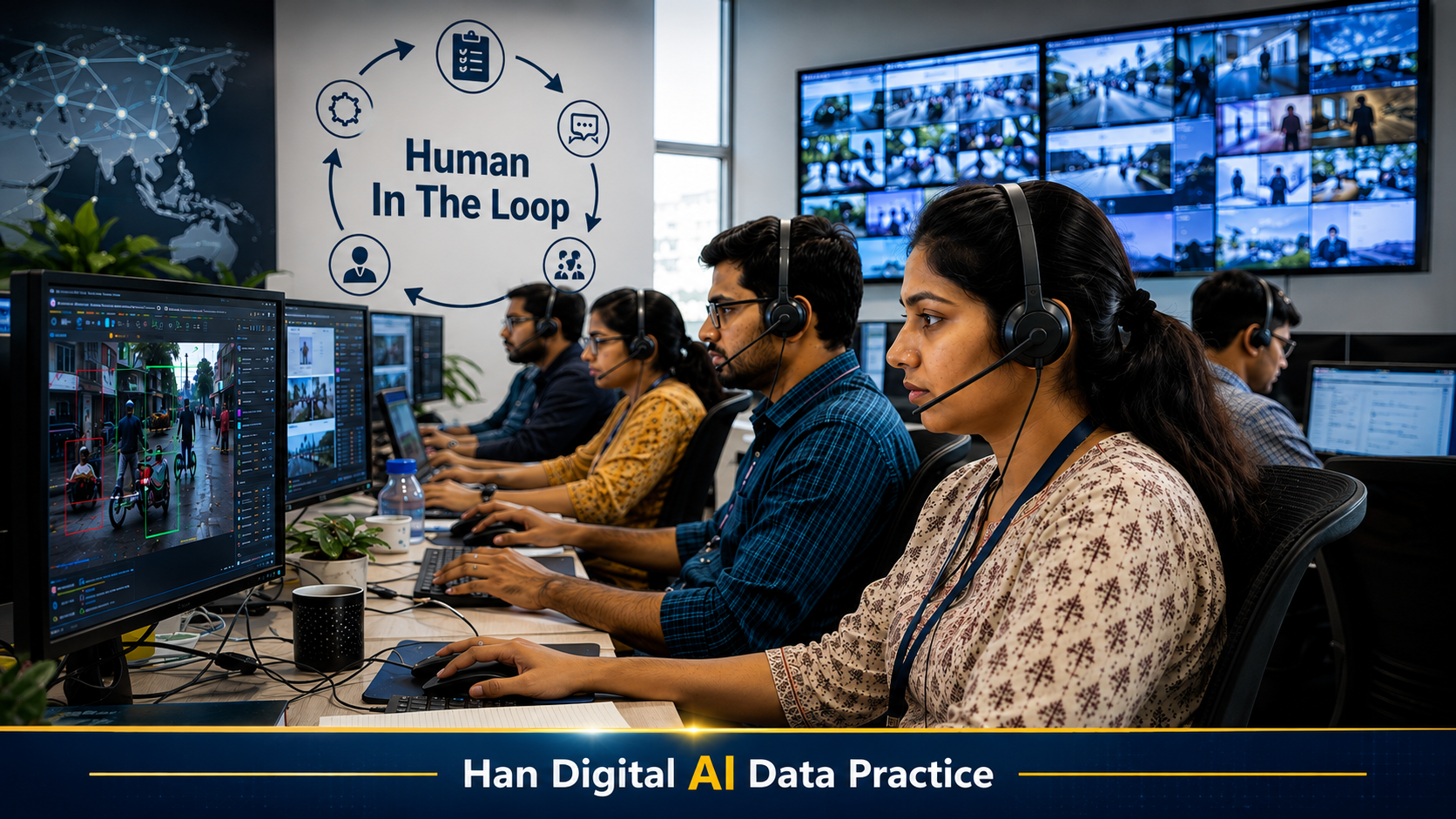
Why the Smartest AI Models Still Need a Human Standing Next to Them
The Model Was Never the Problem
A retail AI once flagged a customer return as “fraudulent behavior” because the shopper had returned three sarees in one month.
The model wasn’t wrong about the pattern. It was wrong about the context that the customer was buying for a wedding, trying different drapes for different aunts, and returning what didn’t fit. No algorithm trained on Western e-commerce return data would ever know that. A human reviewing the case understood it in four seconds.
This is the story that gets left out of most AI conversations. We obsess over parameters, GPUs, and model architecture and quietly ignore the fact that almost every AI failure that reaches a customer isn’t a math problem. It’s a context problem. And context, it turns out, is something only humans can supply at scale, consistently, across the messy diversity of real markets.
That’s the entire premise of Human-in-the-Loop (HITL) training data and it’s why enterprises building serious AI products are no longer treating it as a QA afterthought, but as core infrastructure.
What Human-in-the-Loop Actually Means (Without the Jargon)
Strip away the buzzword, and Human-in-the-Loop is a simple idea: AI should never learn, decide, or act completely alone. At defined checkpoints, a trained human steps in to teach, correct, or validate before the AI’s judgment ever reaches a real customer, patient, or transaction.
Think of it less like “human oversight” and more like three distinct roles a skilled workforce plays across an AI system’s life:
The Context Curators – people who sit with raw, messy, real-world data before a model ever sees it, and decide what “correct” actually looks like. Not just labeling a photo as “shoe” but recognizing that a photo of a chappal on a Coimbatore shop floor needs a completely different tag taxonomy than a sneaker on a Milan runway.
The Reality Checkers – the people who watch the model’s live decisions in production and catch what statistics alone would miss: a chatbot escalating a genuine grievance as spam, a computer vision model missing a pedestrian because of monsoon glare, a resume-screening AI silently down-ranking a candidate for an unfamiliar college name.
The Drift Watchers – the people who notice, months after launch, that the world has quietly changed underneath the model. New slang. New product categories. New fraud patterns. A model trained on last year’s reality, left alone, doesn’t know it’s becoming obsolete. A trained human does.
None of this is about humans doing what AI “can’t” do yet. It’s about building a permanent structure where human judgment and machine speed correct each other, continuously because the moment that loop breaks, quality doesn’t degrade gently. It breaks in public, in front of a customer.
Why This Problem Gets Harder, Not Easier As AI Gets Bigger
There’s a common assumption that better models eventually need less human involvement. The opposite is proving true.
As enterprises move from single-purpose AI (a chatbot, a recommendation engine) to agentic AI systems that plan, act, and make multi-step decisions on their own, the cost of an uncorrected error multiplies. A single mislabelled data point in a foundation model doesn’t just cause one wrong output it can quietly bias thousands of downstream decisions an autonomous agent makes on its own, with nobody reviewing each individual step.
This is the uncomfortable truth enterprises are waking up to in 2026: the more autonomous AI becomes, the more, not less, rigorous the human training and validation layer underneath it needs to be. Autonomy without a strong human-in-the-loop foundation isn’t efficiency. It’s risk, moving faster.
Where This Plays Out – Real Scenarios, Not Textbook Categories
Vernacular Voice AI in Tier-2 India. A voice assistant built for rural agricultural advisory needs to understand a farmer in Erode or Dehradun asking about pest control in a dialect that shifts every 40 kilometers. Generic multilingual training data trained in Hyderabad call centers doesn’t capture that. It takes human annotators who are from that region, understand the idiom, and can correct the model’s confidence when it misreads intent, not just translates words.
BFSI Document Intelligence. A GCC processes loan applications and underwriting at scale trains an AI to extract data from scanned, handwritten, sometimes torn regional-language documents. The model gets the clean documents right 98% of the time. The other 2% smudged ink, an unfamiliar address format, a name written in two scripts on one form is exactly where compliance risk lives. That 2% is where a trained human reviewer earns their place in the workflow, permanently.
Physical AI and Robotics. As industrial and warehouse robots move from scripted tasks to adaptive, sensor-driven decision-making, the training data shifts from static images to continuous streams by depth sensors, force feedback, motion sequences. Humans reviewing and correcting how a robotic arm “reads” an unfamiliar object on a conveyor belt aren’t a temporary phase of development. They’re the mechanism that lets physical AI generalize safely from a controlled lab floor to an unpredictable factory floor.
Conversational Commerce. A D2C brand’s AI shopping assistant is trained to answer questions about fabric, fit, and care instructions. It performs well until a customer asks something culturally specific “Will this hold up during Pongal cooking smoke?” A model with no exposure to that context guesses. A human-curated feedback loop teaches it, permanently, for every future customer who asks something similar.
Each of these isn’t a hypothetical “use case slide.” It’s the same underlying pattern: AI generalizes from what it’s shown. Humans decide what’s worth showing it and catch what it gets wrong before the world does.
Why the World’s Largest LLMs Still Need Human Training Loops
It’s tempting to assume that once a foundation model reaches a certain scale, human involvement becomes optional. The opposite is true the largest, most capable LLMs on the market today (the ones powering enterprise copilots, customer service agents, and coding assistants) are exactly where Human-in-the-Loop training is most active.
A few trends are driving this, and they’re accelerating, not slowing down:
Reinforcement Learning from Human Feedback (RLHF) has become the industry’s default alignment method. Every major LLM release cycle depends on humans ranking and rating model outputs that deciding which response is more helpful, more accurate, or safer than another. This isn’t a one-time training step; it’s a continuous loop that runs across every model update, every fine-tune, every new capability release.
Hallucination correction is now a standing category of work, not a bug fix. As LLMs get deployed into higher-stakes settings legal research, medical information, financial advice of the cost of a confidently wrong answer rises sharply. Human fact-checkers and domain reviewers are increasingly built into the pipeline specifically to catch fluent-sounding but incorrect outputs before they reach a real user.
LLM evaluation and benchmarking has become its own discipline. Model providers now run large-scale human evaluation programs graders scoring responses for reasoning quality, tone, safety, and helpfulness across thousands of prompts, because automated metrics alone can’t reliably judge whether an answer is actually good.
Red-teaming is now a release requirement, not an afterthought. Before a model ships, trained humans deliberately try to break it probing for harmful outputs, jailbreaks, and edge cases automated testing won’t find. This adversarial human layer is what stands between a model in a lab and a model in production.
Non-English and low-resource language performance remains a genuine gap for global LLMs. Most foundation models are still trained overwhelmingly on English and a handful of high-resource languages. Their fluency drops sometimes sharply the moment they’re tested on Indian languages, regional dialects, and code-mixed speech (Tanglish, Hinglish, and similar). Closing that gap isn’t a data problem alone; it’s a human expertise problem, and it’s one of the fastest-growing areas of demand in the HITL and AI training data industry right now.
Multilingual Capability: The Layer Most AI Training Pipelines Still Get Wrong
Nearly every use case in this piece. The vernacular voice assistant, the BFSI documents, the LLM evaluation work runs into the same underlying constraint: AI is only as good as the language and cultural range of the humans training it.
Most annotation and training-data providers can offer a handful of major global languages. Far fewer can offer genuine depth across 50+ global languages and dialects, including the kind of regional, code-mixed, and low-resource language coverage that Indian and global enterprises increasingly need not just translation-level fluency, but cultural and contextual fluency: idiom, tone, sarcasm, regional slang, and dialectal variation within a single language.
This matters more than it sounds. A model that’s technically “multilingual” but trained on flat, literal translations will still misread intent the moment a user speaks the way people actually speak mixing languages mid-sentence, using regional expressions, or relying on context a dictionary-level translation can’t capture. Getting this right requires human trainers who don’t just speak the language, but live inside its cultural context.
This is precisely why multilingual depth deserves to sit alongside RLHF, evaluation, and red-teaming as a core pillar of Human-in-the-Loop training not a side capability, but one of the central reasons the human layer can’t be automated away.
India’s Quiet Advantage: The Human Layer the Rest of the World Doesn’t Have at Scale
Most of the global conversation about AI training data assumes a single, generic “annotator workforce.” That assumption breaks down the moment a model needs to work across India’s linguistic and cultural diversity 50+ major languages, hundreds of dialects, and regional context that shifts every few hundred kilometers.
This is where India’s multilingual, Tier-2 and rural-sourced talent pool stops being a cost advantage and becomes a quality advantage. A workforce that has grown up navigating multiple languages, scripts, and cultural contexts inside a single household is uniquely positioned to catch the nuance a purely automated pipeline or an outsourced team unfamiliar with the region would miss entirely.
The organizations winning the next phase of enterprise AI won’t be the ones with the biggest models. They’ll be the ones who built the most reliable, most contextually intelligent human layer underneath those models quietly, structurally, and at scale.
The Real ROI Conversation
Enterprises don’t invest in Human-in-the-Loop training data because it sounds responsible. They invest because the alternative is expensive in ways that don’t show up until it’s too late:
- A model that has to be pulled back and retrained after a public failure costs far more than the human review that would have caught it
- Customer trust, once broken by an AI making an obviously wrong call, is slow and expensive to rebuild
- Every additional month an AI system runs on stale, uncorrected training data is a month of accumulating decisions that quietly drift further from reality
Human-in-the-Loop isn’t the cost center in an AI program. It’s the insurance policy that lets everything else the model, the automation, the scale which actually be trusted with real decisions.
Building AI That Understands the World It’s Actually Deployed Into
The next generation of enterprise AI won’t be judged on how impressive its demo looks. It will be judged on how it performs on the messy even 2% of cases that never showed up in a clean training set, the dialect the model hasn’t heard, the document format it hasn’t seen, the cultural context it doesn’t have.
That’s the layer HAN Digital AI data operations are built around: a trained, multilingual, contextually-grounded human workforce working inside the loop, not around it and so the AI enterprises deploy is ready for the world it actually has to operate in, not the one it was trained in.
Interested in what a Human-in-the-Loop training data pipeline could look like for your AI systems? Get in touch with HAN Digital AI Data team to discuss your use case at contact@handigital.com