

 Data Annotation
 Data Sourcing
 Machine Learning (ML)
 Tech Annotation
 Robotics AI Data Operations
 Analytics
 Content Moderation
 Medical Annotation
 Off-the-Shelf (OTS) Datasets for AI Training
 Global Talent Data Intelligence
 Talent Consulting & Strategy
 Strategic Recruitment Solution
 Contract Staffing
 Recruitment As A Service (RaaS)
 Executive Search
 RPO Solution
 IT Services Recruitment
 Research and Consulting
 Executive & Leadership Hiring
 BPO Recruitment
 Diversity Hiring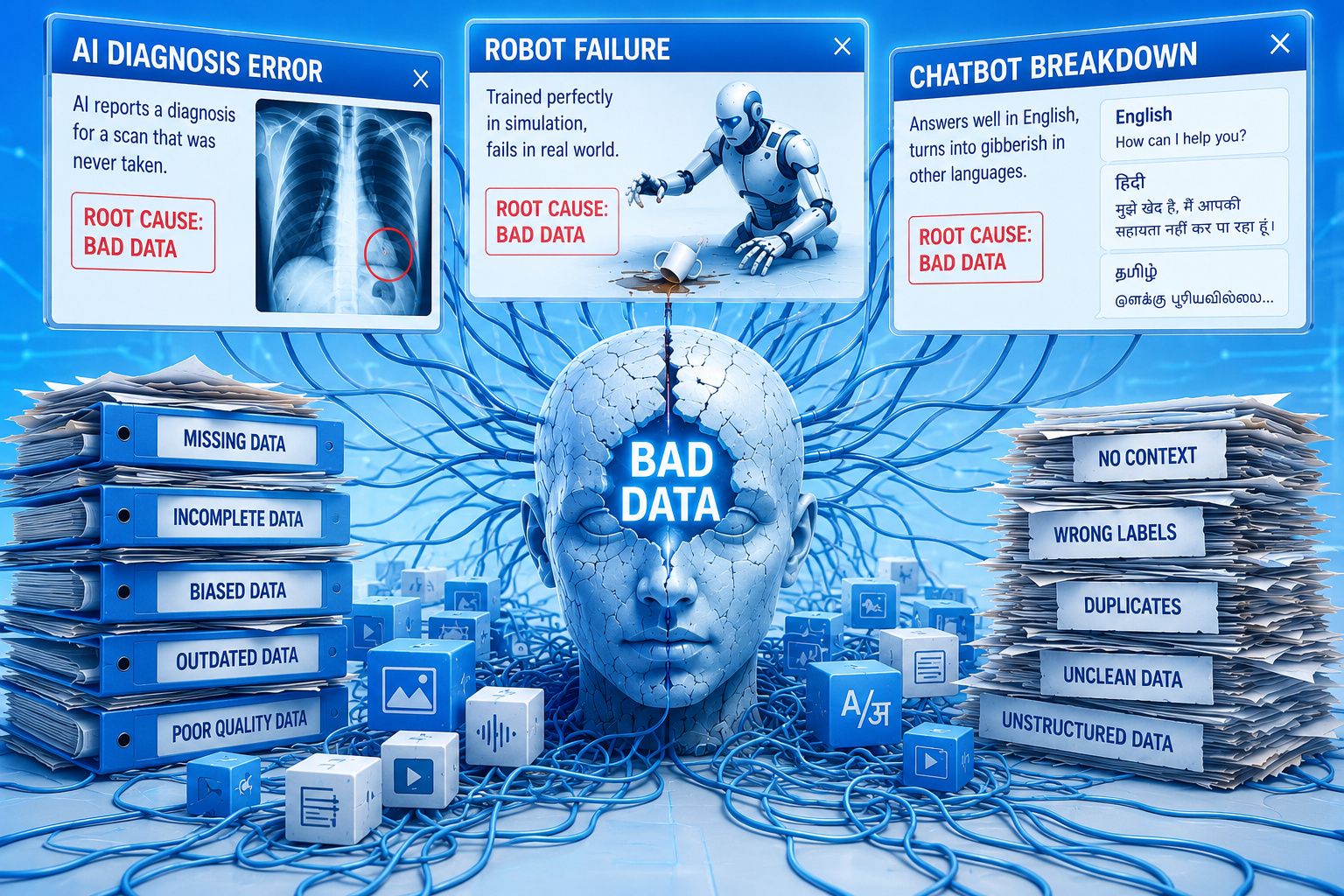
Every AI Company Blames the Model. The Data Was Guilty All Along.
A radiologist reads an AI’s report and finds a diagnosis for a scan that was never taken. A humanoid robot, trained flawlessly in simulation, drops a coffee cup the first time it touches a real one. A chatbot answer fluently in English and turns into gibberish the moment a user switches to Hindi or Tamil. Three different companies, three different headlines, three different apologies about “model limitations.”
None of them were model problems. All three were data problems wearing a model’s disguise.
Every few weeks, a new AI failure makes headlines. A chatbot fabricates a legal citation. An image generator gets history wrong. An autonomous agent takes an action nobody authorized. A model performs brilliantly in English and falls apart the moment a user switches to a regional language. The commentary that follows almost always asks the wrong question: which model failed?
The right question is: what did it learn from, and how well was that data actually built?
We’ve spent the last several years inside the machinery of AI data operations that train large data pipelines, annotation queues, fine-tuning datasets, and evaluation sets. And the pattern is unmistakable. Model architecture gets the headlines. Data precision determines the outcome.
Look across the industry’s biggest names such as OpenAI’s GPT line, Google’s Gemini, Meta’s Llama, xAI’s Grok, Amazon’s Titan/Nova, Anthropic’s Claude and the failure signatures differ by vendor, but the root cause pattern doesn’t:
● GPT-class models hallucinate with high confidence on niche facts and citations when the training corpus is thin or contradictory on a topic that the model isn’t lying, it’s interpolating across a gap nobody filled with precise, current data.
● Open-weight models like Llama inherit whatever data (and whatever gaps) their downstream fine-tuners feed them. Because Meta ships the weights, not a controlled endpoint, data precision at the fine-tuning stage, not the base model that becomes the deciding factor in whether a Llama-based deployment is safe or reckless.
● Grok’s real-time X-grounding is only as reliable as the unfiltered stream it draws from a live-data architecture is a data-curation problem wearing an infrastructure label; without tight moderation and provenance filtering on that stream, the model repeats whatever the crowd is saying, accurate or not.
● Physical-AI and robotics models fail in the real world because, as embodied-AI teams building humanoids for companies like Figure AI, 1X, and Agility Robotics have learned the hard way in 2026, simulation cannot fake contact dynamics, sensor noise, or the countless small physics of the real world. Every serious program has hit the same wall: real-world demonstration data outperforms simulated data even at ten times the simulated scale, because simulators still can’t accurately model how a robot’s fingers interact with soft or irregular objects.
● Agentic systems from Claude Code to GPT-based coding agents which misfire in multi-step workflows when they haven’t seen enough verified task trajectories to know when to stop, escalate, or ask for confirmation, which is exactly why 2026 has become the year enterprises are investing heavily in structured, verifiable agent-training data rather than one-off instruction pairs.
● Every major model line like Gemini, GPT, Llama, DeepSeek included collapses in low-resource languages. A 2026 benchmark across eleven low and extremely-low-resource Indic languages (Nepali, Gujarati, Marathi, Odia, Dogri, Maithili, Rajasthani, Sanskrit, Bodo, Santali, Konkani) found that even the best-performing model, Gemini 2.5, averaged just 58% accuracy, with GPT-5 at 45% and DeepSeek-3.2 at 43.1%. Separately, Telugu-focused testing found English-centric models losing 30~40 points of accuracy the moment they left English, with failures showing up as broken reasoning, script sensitivity, and unintended code-switching. The issue isn’t architecture. It’s that the training corpus for these languages is a fraction of the size and quality of the English corpus every one of these labs optimizes for first.
● Every vendor’s moderation layer whether it’s a standalone safety endpoint or, in Anthropic’s case, safety trained natively into Claude rather than shipped as a separate API is only as current as the coded language, dogwhistle, and synthetic-content patterns it was last trained against. With some estimates suggesting up to 90% of online content could be synthetically generated by 2026, moderation systems trained on last year’s patterns are already behind.
Zoom out, and every one of these “model failures” regardless of which logo is on the model card is actually a data failure wearing a model’s name.
The Data-Dependency Profile of Every Major Model, Side by Side
Global LLM Player | Core Architecture Bet | Where Data Precision Is the Deciding Factor |
OpenAI (GPT-5.x) | Broadest ecosystem, general-purpose scale | Citation/fact grounding at consumer scale the largest user base means data gaps surface fastest and most publicly |
Google (Gemini) | Native multimodality, longest context windows | Leads current low-resource language benchmarks, but even its 58% average accuracy on extremely-low-resource Indic languages shows the ceiling data scarcity still imposes |
Meta (Llama) | Open weights, no controlled endpoint | Inherits whatever data quality (or gaps) downstream fine-tuners bring precision risk shifts from the lab to whoever deploys it |
xAI (Grok) | Real-time X/Twitter grounding | Only as reliable as the curation on its live data stream speed without filtering is a data problem, not a model one |
Amazon (Titan/Nova) | Enterprise-embedded, Bedrock-first | Lower public visibility means data-quality issues are less publicized, not necessarily less frequent |
Anthropic (Claude) | Safety trained natively rather than bolted on | Moderation and refusal behavior is a direct function of how well-curated and current the safety training data is |
No player on this list has solved the underlying problem: models are still exactly as good as the data put in front of them, and every one of them is currently data-constrained somewhere that matters. That constraint is the market opportunity.
Data Precision Is Not a Back-Office Function. It’s the Product.
For years, the AI industry treated data annotation as a cost center something to outsource low cost and move past quickly on the way to the “real” work of model training. That era is ending. Enterprises building serious AI systems in 2026 have learned, often expensively, that:
1. Precision compounds. A 2% labeling error rate doesn’t stay at 2%, it propagates through every downstream fine-tuning cycle and shows up as a systemic blind spot exactly where the model is asked to perform under pressure.
2. Accuracy is domain-specific, not general. A model that reasons well about consumer chat can still fail catastrophically on a financial disclosure, a clinical note, or a factory-floor safety instruction because general-purpose training data was never built to carry that weight.
3. Recency matters as much as scale. Static benchmark datasets built two or three years ago are already stale against how language, slang, threats, and even legitimate business terminology evolve. Continuous, freshly collected, precisely-labeled data has become the actual moat
This is the thesis we operate every day: the organizations that win the next phase of enterprise AI won’t be the ones with the biggest models. They’ll be the ones with the most precise, most current, most domain-grounded data feeding those models.
Where the Frontier Is Actually Moving: 7 Niche Data Categories Reshaping Fine-Tuning in 2026
The generic pretraining corpus web-scraped text, Wikipedia, open instruction sets is now table stakes. Every serious lab has it. What separates a production-grade model from a demo is the next layer: precision-built, niche, domain-specific training and fine-tuning data. Here is where that frontier is moving right now.
1. Physical AI and embodied robotics data. Demand for real-world sensorimotor data, egocentric video, teleoperation traces, LiDAR, force-torque and proprioceptive streams that has exploded alongside the humanoid robotics boom at companies like Figure AI, 1X, Agility Robotics, and Tesla’s Optimus program, all racing against NVIDIA’s Isaac Sim/Cosmos simulation stack to close the sim-to-real gap. U.S. search interest in “physical AI” data grew roughly 3.5x in just twelve months. This is not scrapeable data; every example is a physical action that has to be performed, captured, calibrated, and annotated by someone who understands contact dynamics, motion labeling, and sim-to-real transfer.
2. Agentic and verifiable-reward task trajectories. As enterprises move from single-shot chatbots to multi-step AI agents like Claude Code, GPT-based coding agents, and orchestrated multi-agent systems alike the fine-tuning need has shifted from instruction-response pairs to full verified task trajectories the sequences that show not just the right answer, but the right process, including when an agent should pause for human review. Anthropic’s own 2026 agentic coding research frames this shift explicitly: engineering work is moving from writing code to supervising and verifying what agents produce, which only works if the underlying trajectory data was rigorously checked in the first place.
3. Low-resource and code-mixed multilingual data. Even the strongest frontier models Gemini, GPT-5, DeepSeek, Llama lose significant accuracy the moment they leave high-resource languages. 2026 benchmarking across eleven low- and extremely-low-resource Indic languages put the best model, Gemini 2.5, at just 58% average accuracy, with GPT-5 at 45% and DeepSeek-3.2 at 43.1%. This is precisely where large-scale, linguistically precise, human-curated multilingual annotation earns its premium: it’s the difference between a model that merely translates and one that actually reasons in a language.
4. Trust & safety and synthetic-content moderation data. As synthetic content approaches the majority of everything published online, moderation training data has to be rebuilt continuously, not just for explicit harm categories, but for coded language, evolving dogwhistles, deepfake patterns, and multilingual, multi-cultural nuance that a single-market dataset will always miss. Every vendor faces this regardless of whether moderation is a standalone API (as with OpenAI and Azure) or trained natively into the model (Anthropic’s approach with Claude) the constraint is data freshness, not architecture.
5. Domain-grounded instruction data for regulated industries. Generic instruction-tuning datasets produce generic-sounding answers. A legal document analyzer, a financial compliance assistant, or a clinical support tool needs fine-tuning examples grounded in the actual documents, terminology, and edge cases of that vertical this is now recognized as the dividing line between AI that sounds right and AI that is actually usable in a regulated workflow.
6. Preference, evaluation, and red-teaming data for alignment. As reinforcement learning from human feedback becomes standard practice, the preference signal quality how outputs are scored for helpfulness, honesty, and instruction-following has become its own specialized data discipline, distinct from labeling and requiring structured, consistent human judgment at scale.
7. Hybrid synthetic-plus-human datasets. The industry consensus emerging in 2026 is that neither pure synthetic data nor pure human-annotated data wins alone. Synthetic data delivers scale and privacy-safe volume; human data delivers the judgment, cultural nuance, and safety alignment that synthetic generation still can’t replicate. The winning pipelines blend both, deliberately, rather than defaulting to whichever is cheaper.
Why This Is HAN Digital Group’s Moment
This is not an abstract industry observation for us. It is the operating thesis behind HAN Digital AI Operation practice.
We’ve built our positioning deliberately: AI Data first ahead of Technology, ahead of Research & Consulting, ahead of Talent Transformation because we believe data precision is the foundational layer everything else in enterprise AI is built on top of. Our multilingual delivery bench and our MLOps-trained talent pool are two distinct, complementary strengths are not the same resource wearing two hats, but two separate depths of capability that let us operate across both the language-precision problem and the pipeline-engineering problem at once.
The seven frontiers above are not someone else’s opportunity to watch from the sidelines. They are a direct map of where an AI data operations partner with real linguistic depth, real annotation discipline, and real domain expertise can lead rather than follow particularly in multilingual and low-resource language data, where India’s own linguistic diversity is not a limitation to work around, but the single biggest structural advantage in the market.
The next generation of AI systems won’t be won by whoever trains the biggest model. It will be won by whoever feeds it the most precise data. That is the business we are in.