

 Data Annotation
 Data Sourcing
 Machine Learning (ML)
 Tech Annotation
 Robotics AI Data Operations
 Analytics
 Content Moderation
 Medical Annotation
 Off-the-Shelf (OTS) Datasets for AI Training
 Global Talent Data Intelligence
 Talent Consulting & Strategy
 Strategic Recruitment Solution
 Contract Staffing
 Recruitment As A Service (RaaS)
 Executive Search
 RPO Solution
 IT Services Recruitment
 Research and Consulting
 Executive & Leadership Hiring
 BPO Recruitment
 Diversity Hiring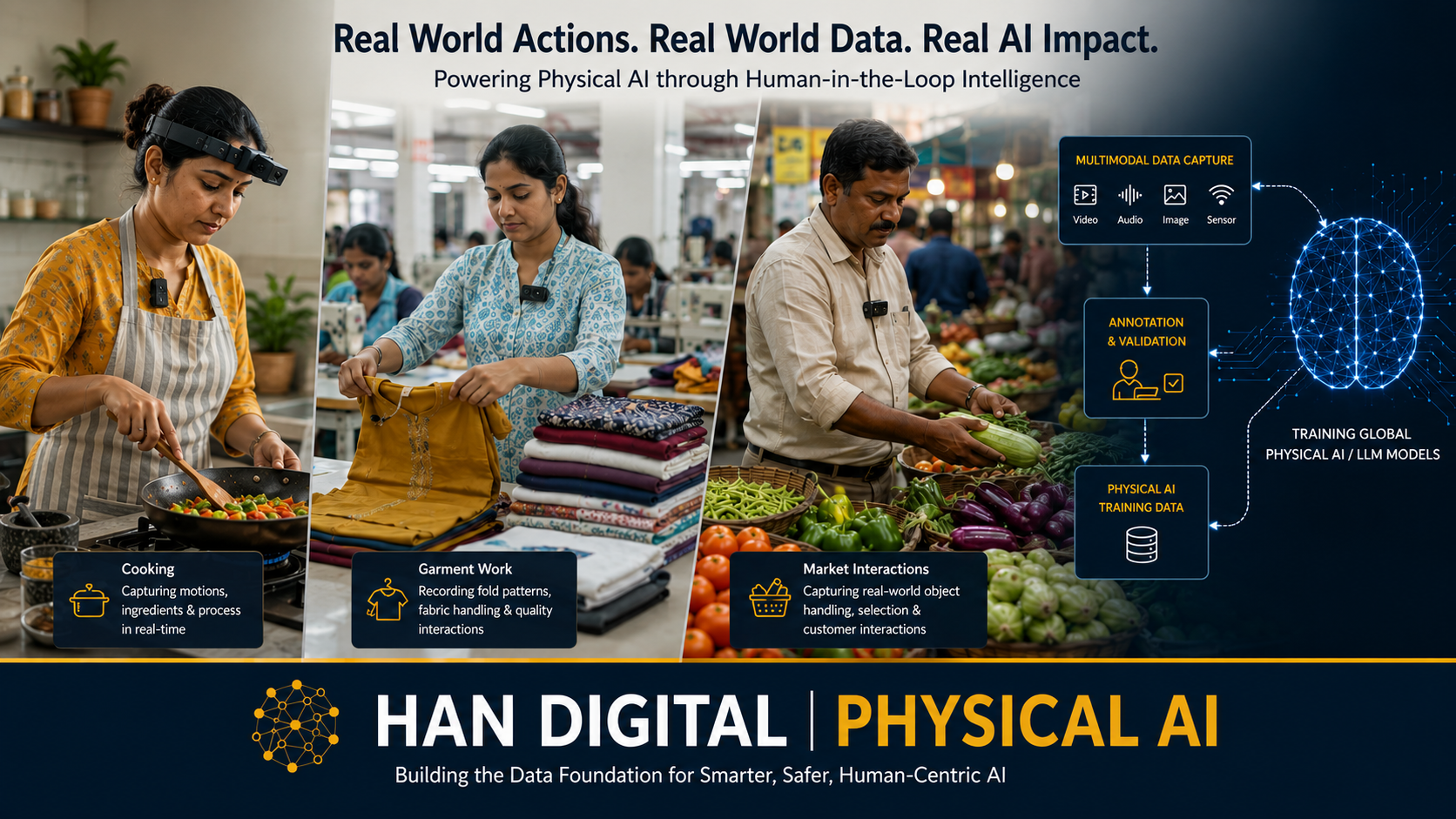
India’s Next AI Advantage Has Nothing to Do Only with Code. It’s Physical AI
As artificial intelligence moves beyond screens and into the physical world with robotics, movement, real human environments thats a new question is emerging: who will train these systems to understand reality itself?
We made the case in a first-of-its-kind broadcast feature with Analytics India Magazine (AIM) about Physical AI along with other industry panelist from humynlab.ai and nextwealth: the answer may well be India.
In the discussion, Founder & CEO Saravanan Balasundaram outlined why India is uniquely positioned to power the next phase of artificial intelligence: Physical AI. While today’s foundation models have been trained primarily on digital data, the next generation of AI systems will depend on high-quality multimodal datasets grounded in real-world human interaction, robotics, vision, movement, and continuous feedback from physical environments. This is where India’s scale, diversity, and depth of human capital become a decisive advantage.
He shared industry perspective on how enterprises are preparing for this shift, drawing on the company’s experience across AI data operations, multilingual model training, data annotation, human-in-the-loop workflows, and enterprise AI deployment. He pointed to India’s large, linguistically diverse, and geographically distributed workforce as critical infrastructure for building the physical-world datasets that Physical AI requires spanning regional languages, varied environments, and real human behavior at a scale few other nations can match.
He also shared practical use cases demonstrating how robust, human-verified training data drives more accurate, reliable, and scalable AI systems across industries reinforcing that as AI moves from digital to physical intelligence, trusted data infrastructure and human expertise become foundational, not optional.
HAN Digital Group remains committed to helping global enterprises build AI systems that are production-ready, responsible, and designed for real-world impact with India at the center of that transformation.
Watch the full conversation: [link]