

 Data Annotation
 Data Sourcing
 Machine Learning (ML)
 Tech Annotation
 Robotics AI Data Operations
 Analytics
 Content Moderation
 Medical Annotation
 Off-the-Shelf (OTS) Datasets for AI Training
 Global Talent Data Intelligence
 Talent Consulting & Strategy
 Strategic Recruitment Solution
 Contract Staffing
 Recruitment As A Service (RaaS)
 Executive Search
 RPO Solution
 IT Services Recruitment
 Research and Consulting
 Executive & Leadership Hiring
 BPO Recruitment
 Diversity Hiring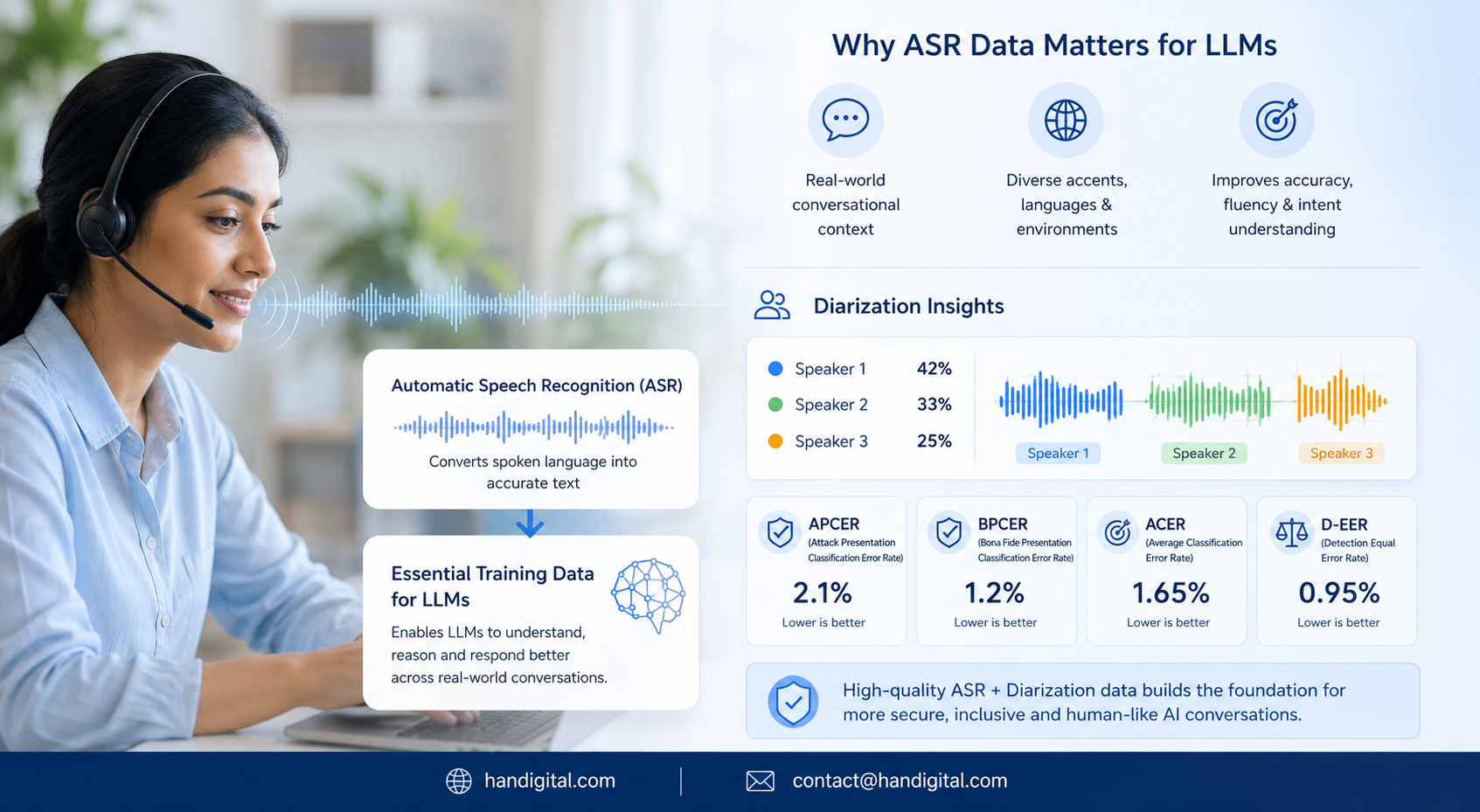
Your Voice AI Sounds Great in the Demo. Then ASR Meets Reality
The demo always looks perfect. Quiet room, laptop mic, one clear voice. Then the model ships, and it meets a call centre in Bengaluru or Manila, a factory floor with machinery running in the background, a customer with an accent nobody on the team happened to speak. Suddenly the numbers slip. The model isn’t broken. It just never heard that world during training.
That’s the ASR dataset problem, and it’s usually invisible until it isn’t. Get the underlying speech data right and everything built on top of it such as transcription, voice assistants, call analytics, dictation tools that gets noticeably easier. Get it wrong, and no amount of fine-tuning fully buys it back.
So what actually makes an ASR dataset good enough to ship on? Here’s the plain-language version.

First, what an ASR dataset even is
Nothing exotic. An ASR (automatic speech recognition) dataset is audio paired with an exact, human-checked transcript of what was said. Thousands of pairs, sometimes millions. The model listens to enough of them and starts mapping sound to words on its own.
Three things decide whether that mapping holds up in the real world: does the audio sound like what the model will actually hear after launch, are the transcripts accurate enough to teach the right pattern instead of someone’s typo, and do the speakers look like the people who’ll actually use the product but not a narrow slice of them.
A model is only as good as the gap between its training audio and the audio it hears on day one. Close that gap, and accuracy follows.
Why the usual starting point runs out of road
Most teams begin with the well-known open datasets like large English and multilingual speech corpora built from audiobooks, parliamentary sessions, podcasts. Genuinely useful for early benchmarking. But they carry the same handful of blind spots, and every team hits them eventually:
• Read-speech bias. Most of that audio is people reading text aloud. Real speech interrupts itself, trails off, doubles back, but none of which shows up much in a read-aloud corpus.
• Thin language coverage. Drop below the top handful of languages and the hours dry up fast. Even within one language, whole accents and dialects barely register.
• Clean-room acoustics. Public data skews quiet and well-recorded. Production audio has traffic, overlapping voices, phone compression, a mic three metres away.
• Generic vocabulary. A model that’s only heard general speech will keep mishearing the words that actually matter to your product like product names, medical terms, financial jargon.
None of that makes these datasets useless. It makes them a starting line, not a finish line, for anything that needs to work outside a lab.
What actually decides dataset quality
Strip away the marketing language and the same five things determine whether a speech dataset holds up whether you’re buying it, building it, or auditing what’s already sitting in your pipeline.
1. Speaker diversity
Age, gender, accent, dialect, speaking pace, fluency, all of it shapes how speech sounds. A narrow speaker pool teaches the model one version of a language, not the one it’ll encounter.
2. Acoustic diversity
Studio audio, phone calls, far-field smart-speaker recordings, a noisy car, two people talking over each other. A model needs the full range, not just the cleanest slice of it.
3. Transcription accuracy
The quiet one that decides everything else. A dataset transcribed carefully, reviewed by a second annotator, teaches the model a clean signal. A dataset transcribed casually teaches it noise and that noise compounds at scale.
4. Language and dialect coverage
Where most “multilingual” ASR datasets fall apart fastest especially for low-resource languages and code-switched speech, where a speaker moves between two languages inside the same sentence without thinking about it.
5. Domain vocabulary
A voice AI model built for banking, healthcare, or logistics needs to have actually heard that vocabulary. Otherwise the everyday terms of your industry get consistently misheard, no matter how good the base model is.
Multilingual is where most datasets quietly fail
“Multilingual coverage” reads well on a spec sheet. Look closer and it’s often a handful of hours per language, mostly formal or read speech, almost no trace of how people actually talk that switching languages mid-sentence, dropping into slang, trailing off.
In markets with dozens of active languages and regional dialects, that gap shows up on day one. A model trained mostly on formal, single-language audio stumbles on code-switching, informal phrasing, regional pronunciation which is to say, on ordinary conversation. Closing it takes purpose-built collection: speakers recruited across regions and dialects, natural conversation instead of scripted reading, and annotators who know how the language is actually spoken, not just how it’s written in a textbook.
What building a custom ASR dataset actually involves
When the off-the-shelf option isn’t enough and for most production voice AI, that moment comes sooner than teams expect that the work shifts to purpose-built collection. In practice, that’s a handful of stages:
• Data Sourcing and recruitment – finding speakers who actually match the target population, not just whoever’s easiest to reach.
• Natural elicitation – task-based prompts and open conversation instead of scripted reading, so the speech sounds like people, not narration.
• Multi-round transcription – one annotator transcribes, a second reviews, a third resolves disagreements. This is the step that keeps error rates low and consistent.
• Speaker and event labelling – who spoke when, timestamps, accent and noise metadata, so the dataset can be filtered and reused later.
• Consent and compliance – documented consent, privacy-aligned handling, secure storage. Not optional when the data is real human voices.
Done properly, a dataset like this stops being a static file and becomes something a team keeps expanding a new dialect here, a new domain vocabulary there, as the product’s needs grow.
Where this lands in the LLM pipeline
Speech data feeds directly into how voice-enabled LLMs actually get built:
• Fine-tuning speech encoders – adapting a pretrained model like Whisper to a new language, accent, or domain, often with a smaller, well-targeted dataset.
• Training speech-LLMs – the newer class of models that connect an audio encoder straight to a language model, which need large, varied speech-text pairs to align sound and language properly.
• Contextual biasing – teaching a model to lean on surrounding context for rare words, names, and jargon which depends entirely on domain-specific transcribed examples.
• Voice assistants and agents – where the bottleneck is rarely the model’s reasoning. It’s whether the speech layer heard the person correctly in the first place.
The architecture gets the attention. The dataset underneath it is what decides whether the thing actually works once real people start talking to it.
Most importantly the metric we measure to identify blind spot.
Speaker-attributed ASR is two systems wearing one output: transcription deciding what was said, diarization deciding who said it. They fail independently, and often invisibly to each other.
Diarization can be flawless while the transcript is garbage. The transcript can be perfect while three words get stolen at a turn boundary. One metric hides one half.
DER (Diarization Error Rate)
DER scores diarization alone, with zero regard for what was actually said. It works in time, checking whether each moment of audio has the right speaker.
It sums three failures: missed speech, false-alarmed speech, and speech tagged to the wrong speaker. Predicted and real speakers get matched first, since labels like “Speaker 1” carry no identity.
DER’s blind spot: a three-second mix-up and a three-minute one score the same, and the words never enter the picture.
WDER (Word Diarization Error Rate)
WDER moves the unit from seconds to words the closer to how a person actually reads a transcript. It checks only words the ASR already got right.
Of those correct words, how many were tagged to the wrong speaker? This catches the classic quiet failure: a turn boundary drifts half a second, three words land under the wrong name.
cpWER (Concatenated Minimum-Permutation WER)
cpWER scores both failures at once, and has become close to a default for multi-speaker benchmarks. Each speaker’s words get concatenated, reference and hypothesis both.
Every possible speaker pairing gets tested; the lowest-WER pairing is the score reported. Merge or split a speaker, and no pairing lines up the penalty shows up directly.
One more worth knowing
JER (Jaccard Error Rate) scores error per speaker, not per second across the file. It matters when talk time is lopsided a busy agent beside a mostly-silent customer.
The takeaway
An ASR dataset isn’t a box to tick on the way to a voice-enabled LLM. It’s the foundation everything else sits on. Speaker diversity, acoustic range, transcription accuracy, language coverage, domain vocabulary that skip any of it, and it shows up later as a model that just doesn’t work as well as the demo promised.
HAN Digital’s AI Data Operations team works at exactly this layer data sourcing, voice recording, transcribing, and annotating speech data built around the languages, accents, and real-world conditions a model actually has to perform in. If your team is scoping an ASR or voice data need, happy to talk through what a fit-for-purpose dataset would look like for your use case.