

 Data Annotation
 Data Sourcing
 Machine Learning (ML)
 Tech Annotation
 Robotics AI Data Operations
 Analytics
 Content Moderation
 Medical Annotation
 Off-the-Shelf (OTS) Datasets for AI Training
 Global Talent Data Intelligence
 Talent Consulting & Strategy
 Strategic Recruitment Solution
 Contract Staffing
 Recruitment As A Service (RaaS)
 Executive Search
 RPO Solution
 IT Services Recruitment
 Research and Consulting
 Executive & Leadership Hiring
 BPO Recruitment
 Diversity Hiring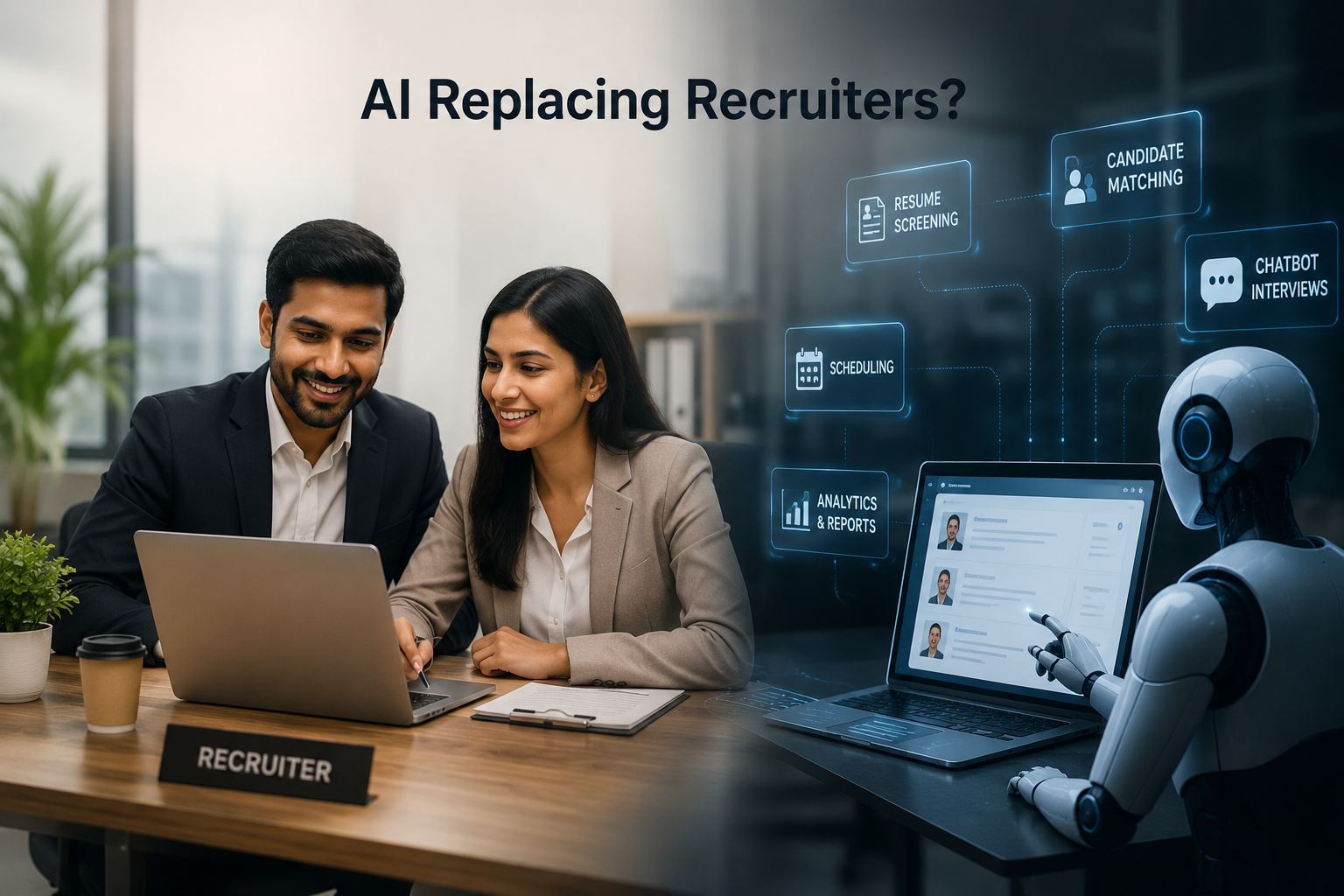
AI replacing recruiters? The real answer is more nuanced than the headlines suggest
 First, the scale of what is actually happening
“AI adoption in recruiting surged from 26% to 43% in a single year. This is no longer a trend, it is a structural shift.”
— SHRM AI in HR Talent Trends 2025
The adoption curve is steep and it is not reversing. But adoption statistics do not tell you whether AI is replacing recruiters or augmenting them. For that, you need to look at what AI is actually being used to do and where it consistently falls short.
 What AI genuinely does well in recruiting?
High AI impact
Moderate impact
Human-led
The pattern is clear. AI excels at tasks that are high volume, repeatable, and data-rich. It saves recruiting teams between 23 and 40 hours per week on administrative work alone (Aeon Hire, 2025). That is real, significant, and worth taking seriously.
But the moment a task requires judgement, emotional intelligence, contextual reading of a person, or long-term relationship capital. AI’s performance drops sharply. Not because the technology is immature, but because these tasks are fundamentally human in nature.
 The honest comparison: what changes, what does not
The recruiter who does only the left column is at risk. The recruiter who dominates the right column and uses AI to eliminate the left entirely from their calendar is more valuable than ever. This is the nuance that the “AI will replace recruiters” narrative completely misses.
The risks nobody is discussing loudly enough

Algorithmic bias at scale. AI trained on historical hiring data replicates historical biases at machine speed. A biased shortlist that once affected 10 candidates now affects 10,000. Only 1 in 3 companies can explain their AI screening logic (Insight Global, 2025).

Candidate experience collapse. Automation without human touchpoints creates a transactional experience that repels senior talent. The candidates you most want to attract are also the most sensitive to feeling like a data point.
Regulatory exposure. The EU AI Act and US EEOC guidance now require explainability and audit trails for AI-driven hiring decisions. Organisations that cannot document their AI’s decision logic face legal and reputational exposure.

Skills erosion in recruiting teams. When AI handles sourcing and screening, junior recruiters never develop the foundational skills to become senior advisors. In three years, organisations may have a pipeline of technically capable but strategically thin talent teams.
 The HAN Digital framework: AI-augmented recruiting
We advise clients to structure AI integration deliberately across the hiring lifecycle — not as a blanket automation of everything, but as a precision tool deployed where it adds the most speed without sacrificing quality or trust.
Attract & sourceAI drafts JDs, optimises for inclusion, runs multi-platform sourcing. Recruiter sets strategy, defines talent pools, and approves messaging tone. Human oversight: high.
 Screen & shortlist
AI ranks and filters by skills match. Recruiter reviews top tier with context AI cannot access motivation, career narrative, compensation expectations. Human oversight: medium-high.
 Assess & interview
AI schedules, transcribes, and analyses consistency. Structured interview questions designed by recruiter and hiring manager. Final assessment: human. Human oversight: high.
 Offer & close
AI provides compensation benchmarking and market comparables. Negotiation, relationship management, and close: fully human. This stage cannot be automated without significant risk.
The principle here is simple: AI compresses the time and cost of the transactional. Humans invest that recovered time into the relational. The organisations that get this balance right hire faster, hire better, and build employer brands that compound over time.
 What this means for recruiting teams right now
Audit your AI tools before they audit your candidates. Map every AI touchpoint in your hiring process. For each one, ask: do we know how it makes decisions? Can we explain it? Can we prove it is bias-free? If not, fix that first.
Redefine the recruiter role, do not just add tools to it. The recruiter of 2026 is a talent advisor, skilled in workforce intelligence, compensation strategy, and candidate psychology. AI handles the pipeline. The recruiter manages the outcome.
Protect the human moments that matter. Identify the three to five candidate interactions where human presence has the highest leverage. These are non-negotiable. Do not automate the moments that build trust.
Build AI literacy, not just AI access. Tools without training produce mediocre output at scale. Invest in upskilling your recruiting team to prompt, configure, and challenge AI — not just use it.
Measure what AI cannot fake. Offer acceptance rates. Retention at 12 months. Hiring manager satisfaction. Candidate NPS. These are the metrics that reveal whether your AI integration is actually working — or just moving faster in the wrong direction.
 Our view at HAN Digital
AI will not replace recruiters. It will replace the version of recruiting that was always transactional, the part that should have been automated years ago. What it cannot replace is the trusted advisor who sits between a business and the people it needs to grow.
The organisations that treat AI as a productivity tool and invest the freed capacity into strategic talent advisory will have a compounding advantage. The organisations that treat AI as a cost-cutting measure and reduce their human recruiting capability will find that the savings come with a hidden price: slower growth, lower quality hires, and a weakened employer brand.
The question is not whether your organisation uses AI in recruiting. The question is whether you are using it with enough strategic intention to actually benefit from it.
— HAN Digital, Talent & Advisory Practice