

 Data Annotation
 Data Sourcing
 Machine Learning (ML)
 Tech Annotation
 Robotics AI Data Operations
 Analytics
 Content Moderation
 Medical Annotation
 Off-the-Shelf (OTS) Datasets for AI Training
 Global Talent Data Intelligence
 Talent Consulting & Strategy
 Strategic Recruitment Solution
 Contract Staffing
 Recruitment As A Service (RaaS)
 Executive Search
 RPO Solution
 IT Services Recruitment
 Research and Consulting
 Executive & Leadership Hiring
 BPO Recruitment
 Diversity Hiring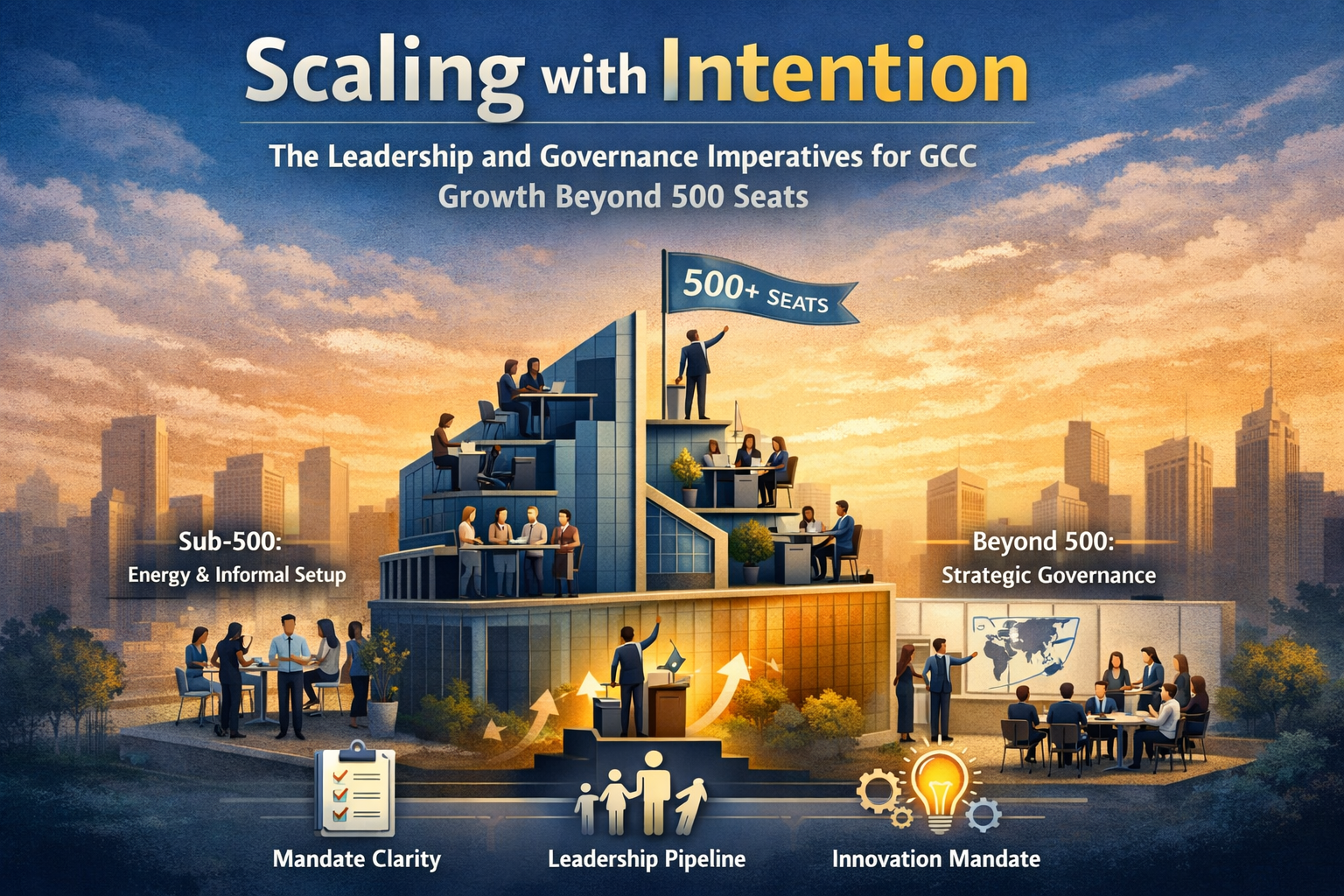
Scaling with Intention: The Leadership and Governance Imperatives for GCC Growth Beyond 500 Seats
Thought Leadership Series | GCC Strategy | 10 min read
Every GCC reaches a structural inflection point. The organisations that navigate it well become capability partners. Those that don’t become very large delivery centres and wonder why the best talent keeps leaving.
There is a moment in the life of every Global Capability Centre that is more consequential than its founding. It is not the day the first hire walks in, or the day the centre crosses 100 seats, or even the day it delivers its first complex project end-to-end. It is the day the organisation crosses the 500-seat threshold and has to decide, consciously or not, what it is actually trying to become.
At sub-500 seats, a GCC can function effectively on energy alone. The team is small enough that everyone knows what the mission is, leadership is visible and accessible, global stakeholders are engaged by novelty, and the centre’s relative youth generates a kind of institutional momentum. Problems get solved by relationships rather than processes. Culture is set by a handful of senior leaders whose values permeate a team small enough to absorb them directly.
Beyond 500 seats, none of that continues to work. The organisation is now large enough to require genuine governance clear mandate boundaries, structured decision rights, formal leadership pipelines, and an explicit strategy for what the centre is building toward. Centres that do not make this transition deliberately find themselves in a paradox: growing in scale while shrinking in strategic relevance.
Understanding the Inflection
The 500-seat threshold is not a precise number it is a proxy for a set of organisational conditions that tend to converge around that scale. By this point, the GCC typically has multiple functional teams, several layers of management, a mix of tenure ranging from founding members to recent joiners, and a global stakeholder landscape that has grown complex enough that informal coordination no longer suffices.
What changes at this inflection is not the quality of the talent or the competence of the teams. What changes is the governance environment those teams are operating in. Without intentional redesign, the structures that worked at 200 seats begin to create friction at 600. Decisions that used to take days begin to take weeks. Clarity about who owns what begins to erode. Senior professionals who joined with expectations of meaningful ownership start to feel that the organisation has grown around them without growing their mandate.
The GCC maturity journey – What changes at each stage
| 1~200 seats | Delivery focus Proving the model. Executing on defined tasks, building trust with global stakeholders, demonstrating quality and reliability. Leadership runs on visibility and energy. Governance is informal. |
| 201~500 seats | Transition zone [where most centres get stuck] The delivery model is working but showing stress. Senior talent is asking harder questions. Global stakeholders want more but mandate boundaries are unclear. Governance gaps begin to compound. |
| 500+ seats | Strategic partner [requires intentional redesign] P&L accountability, innovation mandates, global leadership pipelines, and genuine decision rights. Centres that make this transition deliberately become structurally indispensable to the global organisation. |
The Three Governance Imperatives
For organisations navigating or anticipating the 500-seat inflection, the work is not primarily about hiring more people or restructuring teams. It is about redesigning the governance architecture that determines what those people are empowered to do. Three imperatives define this work.
01. Mandate Clarity
The India centre must know, in specific and documented terms, which decisions belong to it and which require global sign-off. The absence of this clarity is the single most common governance failure at scale and the most damaging to senior talent retention.
02. Leadership Pipeline
The centre needs a deliberate programme for developing India-based leaders who can operate at global peer level, not local delivery managers, but strategic counterparts who can influence, challenge,build relationship with trust and contribute to global priorities.
03. Innovation Mandate
Beyond 500 seats, the centre needs an explicit brief to originate to bring problems forward, to own product or platform outcomes, and to contribute intellectual rather than purely executional value to the global organisation.
The Mandate Clarity Problem
Of the three imperatives, mandate clarity is both the most important and the most consistently neglected. The reason is structural: mandate ambiguity is often more comfortable for global stakeholders than mandate clarity. A centre whose boundaries are undefined can be asked to do anything without formal negotiation. A centre whose mandate is clearly defined has by definition things it will not do, decisions it will make independently, and authority it will exercise without seeking permission.
This discomfort is precisely why mandate clarity requires deliberate executive sponsorship, not just good intentions. Left to evolve organically, the mandate of an India GCC tends to calcify around the lowest-friction interpretation: doing what is asked, as efficiently as possible, without claiming ownership of outcomes. This serves short-term operational convenience while systematically undermining the centre’s ability to attract and retain the calibre of talent it needs to grow.
The most effective governance frameworks for mature GCCs define mandate boundaries across three dimensions: decision rights (what can the India centre decide without global approval), ownership scope (which products, platforms, or processes does the India centre own end-to-end), and escalation protocols (what triggers a global decision, and how quickly must it be resolved). Centres that have formalised these three dimensions consistently report faster execution, lower senior attrition, and stronger global stakeholder satisfaction because clarity removes the ambiguity that creates both frustration and delay.
“Mandate ambiguity is not neutral. It is a slow tax on every senior professional in the centre, paid daily in the form of second-guessing, delayed decisions, and the quiet conviction that real ownership lives somewhere else.”
Building Leaders Who Travel in Both Directions
The second imperative ; leadership pipeline development is where the 500-seat inflection most visibly separates the GCCs that thrive from those that plateau. At sub-500 seats, leadership development can be largely informal: senior individuals learn by doing, are mentored by the centre head, and develop global exposure through the natural demands of a smaller, more intimate organisation. Beyond 500 seats, this model breaks. The organisation is too large for informal development to reach everyone, and the stakes of getting leadership wrong at scale are significantly higher.
What the best-run mature GCCs have built is a deliberate programme for developing what might be called leaders who travel in both directions individuals who are deeply embedded in the India context while simultaneously operating as genuine peers to their global counterparts. This requires three things that most GCCs underinvest in: structured exposure to global strategy conversations (not just project updates), explicit sponsorship by global functional heads, and the creation of high-visibility roles that give India talent accountability for outcomes that matter to the global organisation’s most senior stakeholders.
The talent market in India has noticed this pattern. GCCs with visible, credible leadership development programmes attract a fundamentally different quality of senior candidate than those that rely on compensation alone. The professionals most in demand at the 10–15 year experience level are making judgements not just about what they will be paid, but about where they will be seen, whether they will own something, and whether the organisation has a track record of growing India talent into global leaders or a track record of importing them from abroad.
The Innovation Mandate:
From Contribution to Origination
The third imperative; innovation mandate is the most aspirational and, for many organisations, the most challenging to operationalise. Innovation in a GCC context does not mean setting up a skunkworks team or announcing an innovation lab. It means giving the India centre an explicit brief to originate: to identify problems, propose solutions, own outcomes, and contribute intellectual value that would not exist without the India team’s initiative.
The distinction between contribution and origination is subtle but consequential. A centre that contributes executes on problems that global stakeholders have defined. A centre that originates brings problems forward that global stakeholders had not yet articulated. The first model makes a centre useful. The second model makes it indispensable.
Operationalising origination requires governance changes, not just cultural encouragement. It requires dedicated capacity professionals whose role includes exploring, not just delivering. It requires psychological safety structures that make it acceptable to bring forward ideas that challenge existing approaches. And it requires global stakeholders who are genuinely willing to act on India-originated insights rather than filtering them back to the original delivery framing.
The GCCs that have made this transition and there are a growing number of them, particularly in financial services, engineering, and technology consistently report that their India talent retention at the senior level is dramatically stronger than peer organisations. The reason is not compensation. It is ownership. The professional who knows that something that exists in the world exists because they originated it, owned it, and delivered it that professional is not thinking about leaving.
“A GCC that has crossed 500 seats but has not redesigned its governance is not a scaled-up version of what it was at 200 seats. It is a structurally compromised version of what it could become.”
What This Demands of Global Organisations
The three imperatives outlined above require something from global organisations that is often harder to give than budget or headcount: genuine authority. The transition from delivery centre to strategic partner cannot be manufactured by the India team alone. It requires global leadership that is willing to relinquish some of the control that proximity and hierarchy have historically provided, and to trust the India centre with accountability for outcomes that matter.
This is a governance challenge as much as a talent challenge. Global organisations that are serious about building strategic GCC capability in India need to examine their own governance structures, the decision rights they hold centrally, the escalation triggers that pull authority back to headquarters, and the performance metrics they use to evaluate their India centres. A GCC measured exclusively on cost and delivery metrics will organise itself around cost and delivery. A GCC measured on capability, innovation, and leadership development will invest in those dimensions.
The organisations that will look back on this period as a strategic inflection point in their India presence are those that used the 500-seat threshold not as a milestone to celebrate, but as a trigger to redesign to ask harder questions about mandate, authority, and what they are genuinely trying to build. The answer to those questions will determine, more than any single hiring decision, whether their India GCC becomes one of the great capability stories of the decade or simply one of the largest.